Position assessment for owner-led, knowledge-based companies at a turning point. For owners who know what they are doing and still want to check where energy is being lost. Evidence, not gut feeling.
Book an initial call How I workWhere a company stands rarely shows in a single function. It shows between them.
When a company runs well, its functions mesh. As it grows, silos form and the glue between them is lost. From the inside, people get used to it.
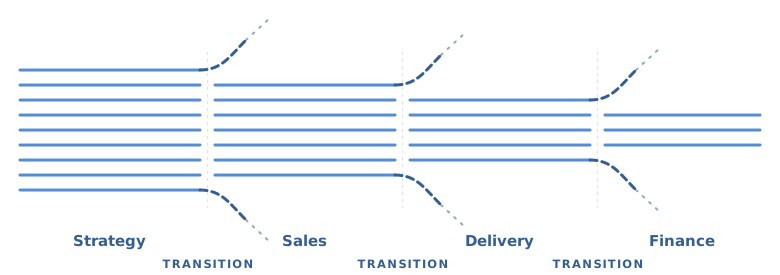
Ask your function heads, one at a time, where the company will be in three years.
Do you get the same answer?
You probably know the answer without trying. And at first it doesn’t seem to matter much. Fairly so: as long as nothing fundamental is at stake, it costs little.
It gets expensive when a decision on direction is due. Then the functions stop working side by side and start working against each other. The result is nearly always the same: the decision gets put off. In my engagements, the gap between first sensing the problem and acting on it was rarely less than one to two years. Each of those years costs options that are no longer there later.
Each function makes sense on its own, and nobody in the building will put that finding to you. That is why it takes so long: in the longest case I have seen, six to seven years.
And if one function is clearly lagging behind? Then the question becomes more urgent, because an investment decision is due. The most expensive option is to reinforce the visible function while the bottleneck sits in the transition before it.
If you sense this, you want to act. The choice usually falls quickly on one of five ways. Each of them can be the right one in certain situations. This overview helps even if you end up choosing someone else.
Click a row to see when that way is the right one.
Before you take any of these ways, you should know where things really stick. That is what I show you: backed by evidence, with a fixed scope and a fixed price. Which way you go afterwards is your decision.
Whichever way you choose, it should meet these three requirements.
Findings with evidence behind every statement. Something you can put in front of your leadership team without having to defend it.
Method and way of working are open beforehand. The first step has a defined end, not an open one.
Someone who carries an owner’s responsibility themselves, and can therefore disagree with you.
Request these criteria as a Buyer's Guide, also for comparing other providers
I measure where the functions work against each other. My tool for this is the 360° Company Health Check. It examines the whole company in one pass, across eight levels from vision to finance. Every assessment rests on evidence. Where statements contradict each other, the findings say so.
You sell something that needs explaining: software, projects, consulting or a mix of these.
This works both ways. In the first conversation I check just as carefully whether I can add value for you. If I can’t, I’ll tell you.

3connected is me: Günther Schmedding. I run the engagements myself. Where extra capacity or specialist knowledge is needed, I bring in experienced colleagues. You know beforehand who they are and why.
I started in sales at Nixdorf in 1986. At Oracle I built up a sales division, and at RealNetworks I set up the German company as managing director, responsible for the DACH region, Eastern Europe and the Middle East. 3connected followed in 2001. I have been responsible for organisations of up to 180 people: built up and sold as founder and shareholder, run as an employed managing director and as interim CEO.
So you don’t have to explain your business to me. And because I am an owner myself, I can disagree with you when it matters.
I have been a member of the Entrepreneurs' Organization (EO), a worldwide network of business owners, for many years. There I host the calls of the European Forum Chairs.
“I would rather tell you early what I see than tell you late what you wanted to hear.”
No. My engagements are confidential, and yours would be too. So I show you the work itself instead. A reference call tells you that someone was satisfied. A complete sample analysis tells you what you get at the end.
How such engagements run is shown in anonymised case studies: starting point, approach, result, no names.
You decide. The first step has clear limits and a defined end. The findings give you a factual basis from which the next steps can be justified. Whether you take them with me is a separate decision. At worst you have a solid overview to use as you see fit.
In my experience it goes like this: first the direction is settled. Then the work happens where the findings show the biggest lever, often in sales. What emerges is the same thing that makes a company saleable: an organisation that holds up even without you at the top. That is why more than half of the engagements ended in a sale of the company: not as the aim from the start, but as an option that ran alongside from the start. You can’t book this sequence. It is an observation from my own engagements. Where your path ends, you decide along the way.
A single person. That is the objection, and it is fair: you would be swapping one dependency for another. But the alternative is not free of risk, just labelled differently. With a firm whose staffing changes, the risk lies in the changes themselves, and you only find out afterwards who actually did the work. Here you know beforehand. What you buy is experience of carrying responsibility, and that can’t be spread across a team.
Three fields where the work usually continues after the position assessment.
It starts with a structured diagnostic conversation. It ends with a results presentation of the findings and prioritised levers, in front of your leadership team if you wish. Then you decide.
Book an initial call Request the Buyer's Guide
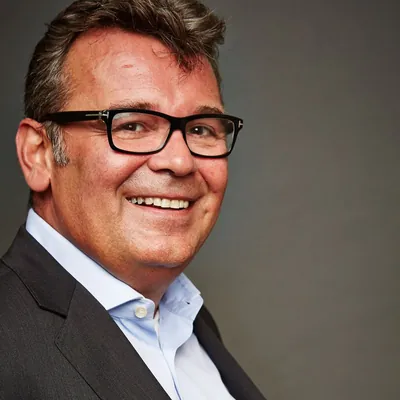
Günther Schmedding
Founder and Managing Director of 3connected GmbH.
g.schmedding@3connected.de · +49 177 44 99 66 8 · LinkedIn